

ARCHAEOLOGICAL HERITAGE
The Cenobio de Valerón is the most renowned archaeological site in Santa María de Guía, and one of the most important on the island. However, there are many other sites that indicate that the territory that today makes up our municipality, and which formerly formed part of the kingdom of Agáldar, was highly valued by the ancient Canary Islanders, probably because of the richness of its fields and the abundance of water.
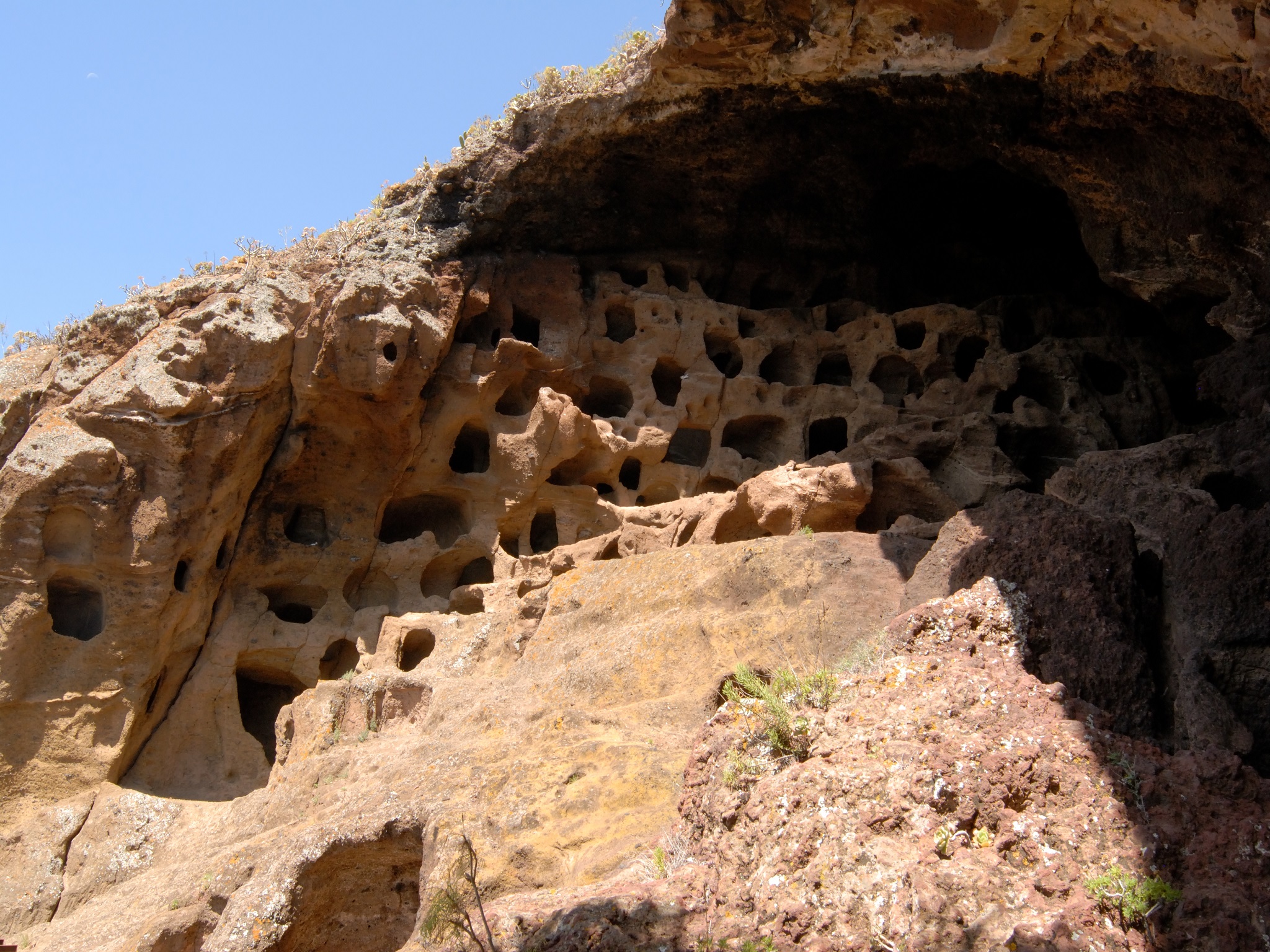

Cenobio de Valerón
The Cenobio de Valerón is the largest collective granary in the Canary Islands and one of the most important in North Africa. Declared an Asset of Cultural Interest in 1978, it is located on the slope of the El Gallego Mountain.
The ancient Canaries built this granary taking advantage of a natural arch of more than 25 metres high and 30 metres wide, and inside they built more than 300 caves or silos of different sizes for storing food and utensils such as tools or idols.
Tagoror de El Gallego
At the top of the mountain whose slope sits the Cenobio de Valerón, is the Tagoror de El Gallego, a structure carved into the rock, with six cavities, which seem to have been used as seats. According to research, this type of structure was used by the ancient Canaries as a meeting place where the nobles held assemblies to discuss aspects of socio-political life.
Camino de Silva
Also known as Cuesta de Silva, it is the only aboriginal path that is recorded as such, of all that existed and that were later reused as bridle paths. Its name is due to the Portuguese conquistador Diego Silva, of whom the chronicles say, he entered the kingdom of Agáldar with his hosts to the Tagoror area, where they were captured by the aborigines and later released and helped, to the surprise of the Portuguese.
Other archeological sites that are a sample of the archaeological wealth of our municipality are the burial places such as those found on the hillsides of El Palmital, Farailaga or the Barranco de El Río among others, and settlements such as those of Montaña de Vergara, La Degollada, Anzo (known also as Tirior), where the ancient Canarians built another important granary.