

VISIT GUÍA IN 5 HOURS
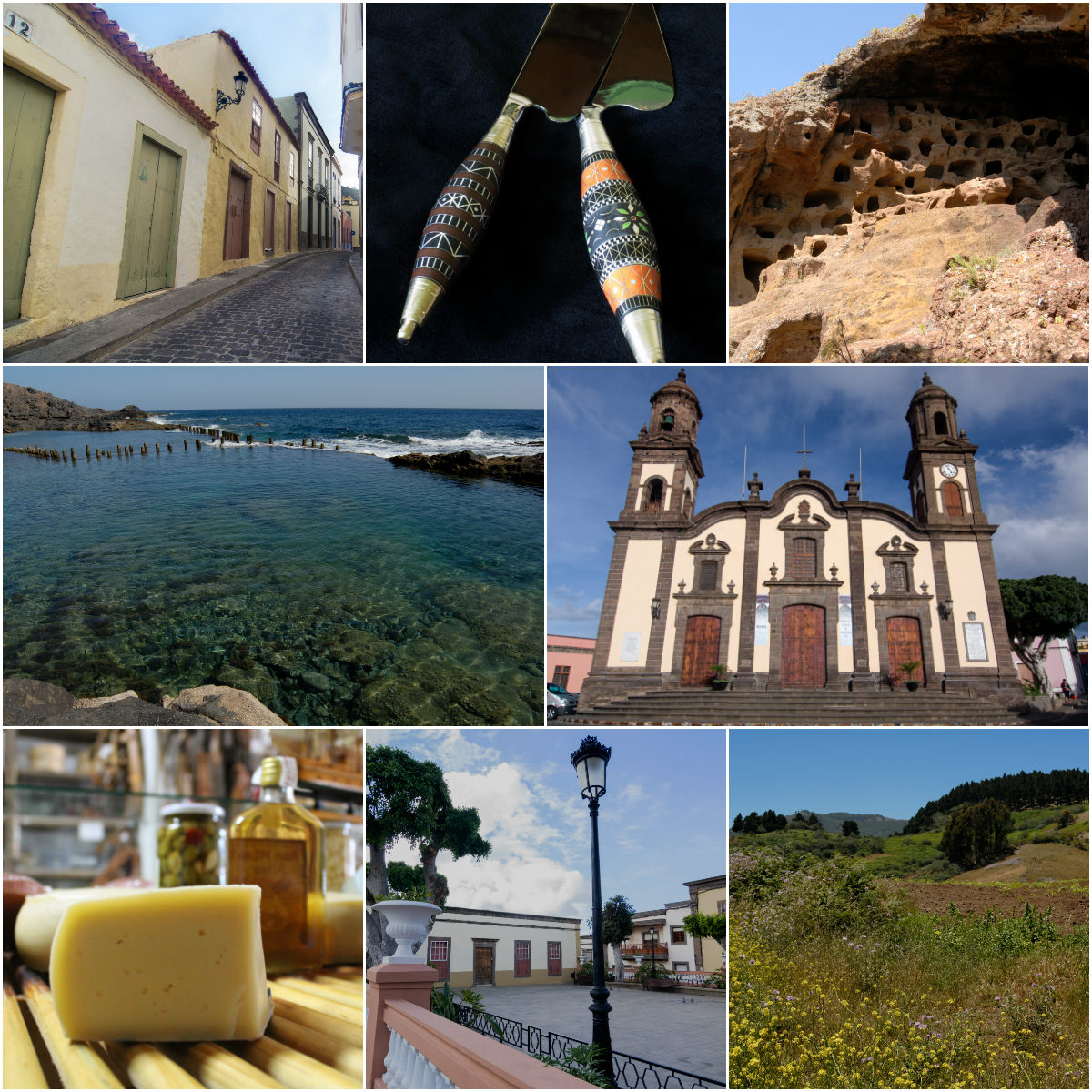
When you visit Santa María de Guía, just a few minutes will suffice to realise the wealth of heritage it possesses. But so that you don't miss out on everything that our municipality has to offer, we have prepared this route with which you will have the opportunity to walk through streets full of history and with a lot of charm, observe valuable works of art, discover centuries-old crafts, delight yourself with the taste of the gastronomic jewel of the Canary Islands, the Flor Cheese, and discover the secrets of its elaboration in the Casa del Queso; transit through what was the great grain pantry of our aborigines, the Cenobio de Valerón; and enjoy beautiful landscapes of calm beauty. A journey from the coast to the summit that will transport you to ancient times and dream corners.
The tour begins at the Cenobio de Valerón, the first point on this route as it is almost at the entrance to the municipality. This archaeological site, made up of almost 300 caves carved into the volcanic tuff and located on the Cuesta de Silva (GC-291), is the most spectacular and largest pre-Hispanic granary in Gran Canaria. During the visit, in addition to learning about the relevance of agriculture in the productive model of the ancient Canaries as a fundamental pillar of their livelihood and in their sociopolitical organisation, reference is made to the flora and fauna of the area, to volcanic geology of the place and, of course, to all the archaeological aspects of the site.
After the Cenobio de Valerón, a visit to the Old Town (declared a Historic-Artistic Monument) is a must. A tour through its streets allows us to notice the beauty of its buildings and transports us to the splendour of yesteryear. Among its buildings, the Parish Church (built between the 17th and 19th centuries) stands out, with its baroque façade flanked by two neoclassical towers and inside which important works of art are preserved, among which are altarpieces and images of the famous sculptor from Guía, José Luján. Perez; the Casa de los Quintana (manor building from the 16th century); the birthplace of Néstor Álamo (17th century) and the Hermitage of San Roque (16th century, restored in the 19th century in an eclectic style). Other places of interest within the Casco are the Panificadora where the typical Guía sweets are made in the traditional way; the craft workshops where you can check out the manufacturing process of Canarian knives (their handles are made from goat's horn) and wood carving and the establishments where you can taste the Guía Cheese. During the tour, numerous and splendid examples of the varied architecture that resides in the city are also observed, where the Gran Canarian façade and neoclassical architecture stand out, which have in this space one of the best manifestations of the archipelago.
Also in the Historic Centre is the Néstor Álamo Museum, in the house where this illustrious Guian, musicologist and historian was born in 1906. The visit offers the possibility of understanding and enjoying the evolution of music in the Canary Islands, from those sounds created by the indigenous people some two thousand years ago to what is now heard in all corners of the archipelago, stopping at all those influences that shaped our music and culture. This discourse takes place through the different rooms of a stately building from the 17th century and, of course, having as its common thread the figure and work of the versatile Néstor Álamo, who also dedicated a large part of his life to research, the recovery of traditions, and ultimately to disseminate the history and culture of Gran Canaria.
Here you can make a stop to eat at any of the restaurants, bars and cafeterias in the city where exquisite dishes of traditional food are offered, always accompanied by the best cheese, or you can go directly to the Montaña Alta estate, where the Casa is located. del Queso and where you will also find several restaurants, also specialised in traditional and homemade food and in which the typical stews appear on the menu each day.
Before or after the meal, you cannot miss visiting the Casa del Queso, where you can enjoy a complete cheese experience. Located in a rural environment from where you can see the pasture areas and on the slopes of El Pico de Montaña Alta, at the top of which there is a viewpoint with 360º views of the four cardinal points, the visit offers you to soak up, in addition to the aromas and flavours of cheese, the history and tradition of this unique product with a protected designation and its characteristics, as well as the entire ethnographic component that revolves around its production.
And if you still have time, continue from there towards the midlands and summit areas of the municipality to enjoy a wonderful landscape, calm beauty and contrasts. With gentle hills and deep ravines, abundant vegetation and pine forests and green pastures, volcanic nature and spectacular views. And if, on the other hand, you prefer to enjoy the sea, bathe in natural pools with crystalline waters or surf the best waves, you can end the afternoon on the Roque Prieto coast or on San Felipe beach.