

Miguel Santiago
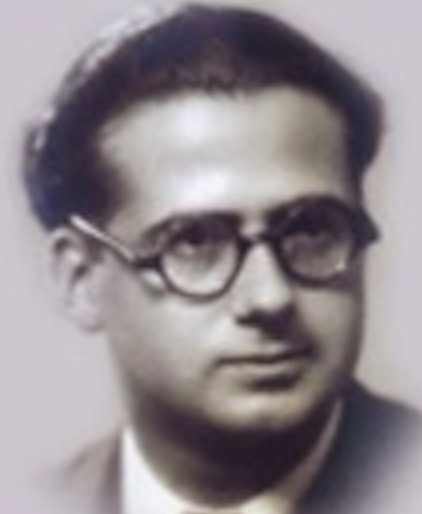
He was born in Guía de Gran Canaria on 28th September 1905; his father, Sergio Santiago Roque, was a watchmaker by profession and his mother, María Rodriguez Sosa (known as Mariquita la de Maestro Sergio), was busy with housework.
He received his primary education in the Public School of his home town, especially from the National Teacher Mr. José Valenzuela Silva, who instilled in him a special interest in Grammar and Literature.
After the great economic crisis produced in the Islands by the First World War and the blockade to which the Islands were subjected, to the point that most of the people went hungry, a circumstance from which the biographer could not exempt himself, he moved to the capital of the Island, Las Palmas de Gran Canaria, where under the protection of his uncles he studied to become a teacher, starting at the age of 16 and finishing at 19. He obtained the highest marks and the title of Extraordinary Prize, the only one awarded, in 1923. He was immediately assigned to a rural school in the most rugged and isolated part of Gran Canaria, in Tasarte, a district of the village of Aldea de San Nicolás, where he served for 8 months.
In the meantime, and because he was unable to take part in two successive examinations for the National Teaching Profession due to his age, he examined himself at the Instituto de Segunda Enseñanza in Las Palmas in the complementary subjects required to become a Bachiller, a qualification he obtained in 1925.
In September of that year he was granted a scholarship by the Cabildo Insular de Gran Canaria to further his studies in the Peninsula, where he moved in October of that year, beginning the first year of Philosophy and Letters, in which he obtained in May 1926 an honours degree in all three subjects, with Professors Hurtado, Besteiro and Ballesteros. In the following courses, in the Literature Section, until the end of his degree, he also obtained Honours and Outstanding marks in almost all the subjects, and finally he was awarded the Extraordinary Prize in the Degree in September 1930. His professors were, among others: Alemany, Bolufer, Cejador, Morales Oliver (Assistant), Millares Carló, Asín Palacios, Garcia Gómez (Assistant), Américo Castro, Dámaso Alonso (Assistant), Menéndez Pidal, Ovejero, Daza, González Palencia, Millás Villacrosa, Mélida and Ferrandiz. He made two university excursions with Professors Ovejero, Termo and Gómez Moreno, one to Andalusia in 1927-28 and another to the South of France and Italy (including Sicily) in 1929. In the last year of his degree and during his Doctorate in Letters (1929-1930) he specialised in Phonetic Studies with a view to the formation of the Linguistic Atlas of Spain. At the same time, he taught at the Lycée Français in Madrid.
When he obtained a post by competitive examination in the Faculty of Archivists, Librarians and Archaeologists in 1931, he was assigned to the Archives of the Treasury Delegation and Provincial Library of Zamora; for this reason he had to abandon the special phonetic training he had undertaken.
In Zamora he reorganised the Treasury Archive and especially the Provincial Library, transforming it from its foundations and its service into the current Public Library.
"Fernández Duro". At the same time he created the Provincial Historical Archive, which was later reorganised.
He taught at the "Purísima Concepción" Secondary School and at the "Claudio Moyano" Secondary School in Zamora as an assistant.
In September 1934 he was commissioned by the Junta de Intercambio y Adquisición de Libros to inspect and advertise the Municipal Libraries in the Canary Islands, creating the one in Guía; as a result of this visit, several libraries of this type were put into operation and created in the Islands.
In February 1935 he was transferred to the National Library at the proposal of its Board of Trustees and assigned to the Topographical Index; he worked there until he was arrested along with all the staff of the Library on 2nd October 1936.
At the same time, from 1935, he worked at the Centre for Historical Studies with the archivists Messrs. Barón Vallejo and Bordonau Más, under the orders of Ramón Menéndez Pidal, on the preparation of the publication of the "Crónica de 1.344" and other historical-literary texts, such as the "Reliquias de la Poesía épica española" (Relics of Spanish Epic Poetry), etc.
He took refuge in October 1936 in the Central Hospital of the Red Cross, and in November 1937 he moved to Murcia, where he worked in the University Library and Archaeological Museum of Murcia.
He was appointed Director of the Archive-Library of the Ministry of Foreign Affairs in July 1966.
He held the Commendation of the Order of Civil Merit, the Order of Isabella the Catholic and the Order of Leopold II of Belgium.
HISTORICAL AND PROFESSIONAL WORKS
Apart from several articles in newspapers and magazines, related to the organisation and diffusion of Libraries, especially the popular and municipal ones in Zamora and the Canary Islands, he has published the following works:
"Catalogo de las obras de Cervantes de la Biblioteca de D. José Mª Asensio y Toledo".
Critical edition of the "History of the Canary Islands", by Pedro Agustín del Castillo.
"La Piratería, El Corso y las Invasiones contra las Islas Canarias durante los siglos XVI, XVII y XVIII" (Piracy, Privateering and Invasions against the Canary Islands during the 16th, 17th and 18th centuries).
"Bibliographical classification by the decimal system of the works of Spanish Pharmacists", compiled by the Pharmacist Colonel Rafael Roldán.
"On Bergeron's two editions of 1630 of "Le Canarion" by Boutier and Le Verrier" (Revista de Bibliografía Nacional, 1946).
"Sir Charles Windom in the Canary Islands" (Revista de Historia).
"Anonymous Compendium of the History of the Canary Islands in the first quarter of the 18th century (in "El Museo Canario") (Edition of a ms. of the National Library).
"Documents referring to the Canary Islands" contained in Catalogue XIII of the General Archive of Simancas (The Canarian Museum)".
"Documents referring to the Canary Islands in the Archive of the Territorial Court of Seville" (The Canarian Museum).
Apart from the publications on the Canary Islands, together with colleagues from the Archives and Library of the Ministry of Foreign Affairs, he wrote several catalogues of the Library's collections in 1941, 1943 and 1949.
"Catalogue of the Cervantes Library by José Mª de Asensio y Toledo. Prologue by D. Angel González Palencia and Presentation by D. Enrique Lafuente Ferrari" - Madrid 1948 (This Library was later acquired by the National Library for the Cervantes Section).
"Documents and Genealogical Manuscripts" - Archives and Libraries Guides - Madrid - 1954.
"Exhibition of the Spanish Religious Book in Rome" organised by the General Directorate of Cultural Affairs of the Ministry of Foreign Affairs.- Madrid.- 1950.
"Los Manuscritos del Archivo General y Biblioteca del Ministerio de Asuntos Exteriores", published in the Revista de Archivos, Bibliotecas y Museos; January-December 1967 (Advance of the Catalogue published after his death).
"The first translation of the Fuero de Madrid. A manuscript that deserves to be published" - Homage to Federico Navarro. Miscellaneous studies dedicated to his memory. ANABA - Madrid 1973 (1972).